Academy | How to Think in Chess
Chess is a complex game, and without a practical thinking process to guide you, your thinking will become disorganized.
To avoid this, I recommend you structure your general thinking around a process that is simple, logical, and easy to remember:
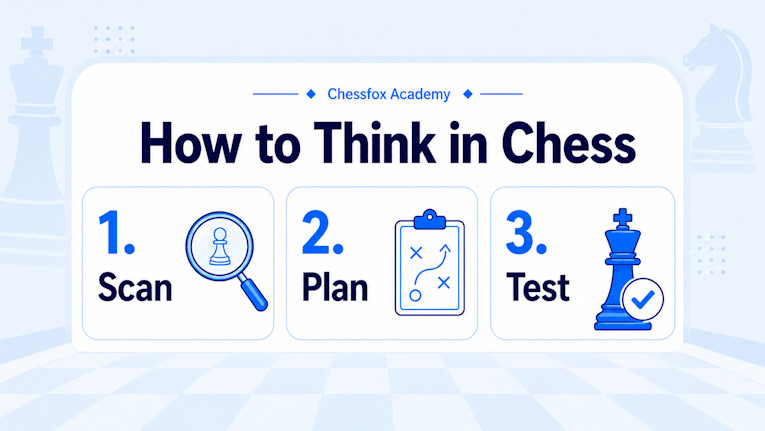
Scan. Plan. Test.
Let’s look at each aspect more closely and clarify what it means in practice.
1. Scan
Always scan the board for tactics.
GM Gabuzyan Hovhannes from ChessMood, in his course on calculation, presents a useful warship analogy:
“Turn on the radar.”
Imagine a warship continuously scanning the waters for potential threats. In the same way, as a chess player, you should develop the habit of scanning the whole board for tactical threats and opportunities.
2. Plan
Your plan is simply the objective you choose to play for. It does not need to be complicated — it could be as simple as activating a passive piece or deciding to attack a specific area of the board.
Having a plan helps you coordinate your forces toward a common goal and makes it easier to find useful candidate moves.
Your objective does not have to be perfect, but it is important to have one, because in chess, even a bad plan is often better than no plan.
3. Test
In this part of the process, you are calculating and comparing your candidate moves before choosing one.
The goal is not to calculate everything, but to test the most important lines well enough to choose the move that best supports your plan and avoids tactical problems.
The Skills That Make the Process Work
Scan. Plan. Test. These three steps give you a practical way to organize your thinking, but the process only works well if you develop the skills behind it. That is the focus of Chessfox Academy: helping you train the skills that make this process work.
In the next lesson, I’ll give you a quick overview of the 7 fundamental chess skills you need to become a strong chess player.