Tip: When identifying CCT moves—especially during training—it can help to follow a set order: queen, rooks, bishops, knights, pawns, and king.
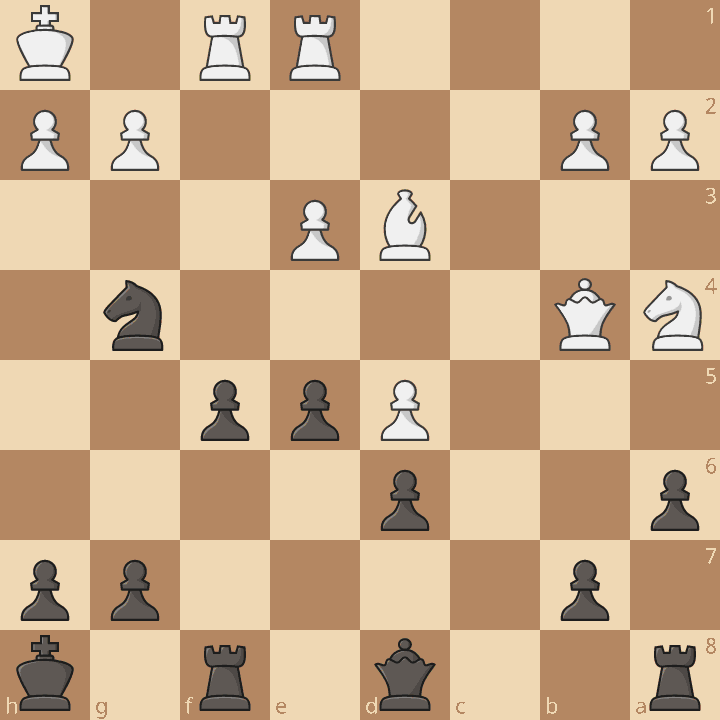
CCT Observations
- We start by identifying the opponent’s CCT moves: 2. Qxb7, 2. Qxd6, 2. Rxf5, 2. Bxf5, 2. Nb6, and 2. h3.
- We can quickly discard 2. Qxd6 because the pawn is defended.
- For now, we can also disregard 2. Nb6 and 2. h3, as these aren’t serious threats.
- The real threats are 2. Qxb7, 2. Rxf5, and 2. Bxf5. Our next move should either defend against these threats or create an even stronger one.
- Moves we can consider are: 1… Qh4 (threatening Qxh2#), 1… Qg5 (supporting Nxe3), 1… Nxh2, 1… Nxe3, 1… e4, 1… b5, and 1… a5.
- However, you should consider your most promising moves—those that create the strongest threats—first. Since 1… Qh4 threatens mate in one and forces White to defend passively, this move should be our primary focus.
- After 1… Qh4 2. h3 Nf2+ (a discovered attack on White’s undefended queen on b4), black’s position is clearly winning, and there is no need to calculate any further.
When you uncover a winning move, there’s no need to consider other options, which is why you should calculate your most promising moves first.