Chess is a thinking game, and many positions can feel chaotic if you do not have a clear way to make sense of them.
That is why training your thinking method is such an important, and often neglected, part of improving your chess. A reliable thinking method gives your mind the structure it needs to stay focused, disciplined, and practical.
You do not need a strict, complicated algorithm for every move. But there are a few critically important parts of your thinking process that you can, and should, work on. Here are the three main things you should be thinking about during a chess game:
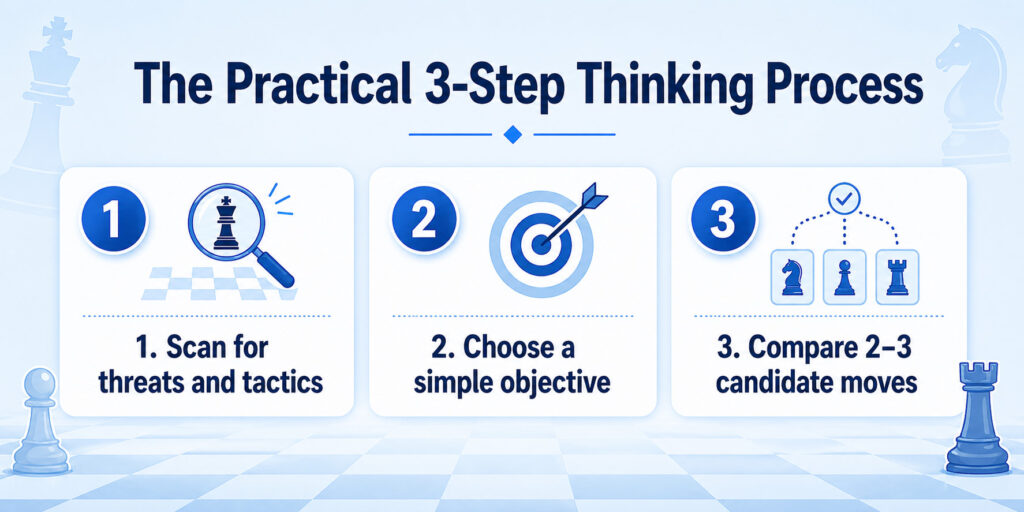
1. Scan for threats and tactics
You should always be aware of the tactics and potential tactics that exist on the board. Scanning the board like a radar for threats, captures, checks, and potential tactical ideas should become a habit. This habit will help you avoid simple mistakes and improve your tactical skill by developing your tactical awareness.
2. Choose a simple objective
Your objective does not need to be complicated. It could be as simple as completing the development of your pieces, launching an attack on the enemy king, trading into a good endgame, or preventing your opponent from achieving their obvious objective.
The point here is that being aware of a useful objective is a powerful tool that helps you make progress in the position. Your chosen objective does not have to be perfect, but it is important to have one. In chess, it can even be true that “a bad plan is better than no plan.”
3. Compare and check 2–3 candidate moves
Once you have chosen a likely objective and you are aware of the tactical nuances in the position, choose two or three reasonable candidate moves that seem to advance your objective. Compare them, and check whether they actually work. Always consider your opponent’s possible replies before making your final decision.
If one of your candidate moves appears to serve your objective well, you should probably make that move. If you have the time, you can spend a few moments checking whether you have something even better. But most of the time, the most practical approach is to make a good move when you find it.
Keep in mind that the purpose of your thinking method is not to find the perfect move every time. That is simply humanly impossible. Instead, the goal is to help you think clearly and guide your thinking in the right direction.
In order for your thinking process to be effective, it must be supported by practical chess skills such as tactics, calculation, and positional understanding. Without these skills, your thinking method will only be an empty shell with no real substance.
In other lessons, I will present the 7 important skills that support your thinking process. In the meantime, consider these 3 aspects of a clear, effective thinking method and try to implement it.