Develop the skills that make a difference in your games with focused lessons, clear explanations and carefully selected exercises.
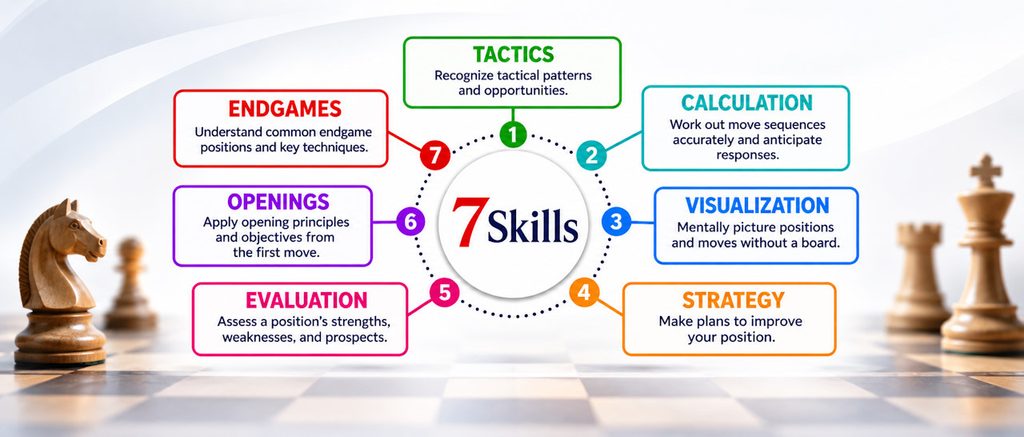
A Better Way to Improve Your Chess
The best way to improve your chess is to make your training specific, focused, and purposeful. Focusing on developing specific chess skills is more effective than simply accumulating more chess knowledge.
Below are the seven skills that have the greatest impact on your performance in real games.
01 Tactics
A chess tactic is a sequence of moves used to exploit targets in your opponent’s position. Many tactics are based on recurring ideas, called patterns or motifs.
The more familiar you become with tactical patterns and understand their underlying ideas, the easier it becomes to recognize opportunities in your own games.
Enter the Tactics Training Room →
02 Calculation
Calculation is the ability to foresee the consequences of a sequence of moves, especially in forcing lines. Strong calculation skills help you verify your ideas faster and minimize mistakes.
Enter the Calculation Training Room →
03 Visualization
Visualization is the ability to see moves and positions in your mind without moving the pieces on the board.
Strong visualization skills help you follow variations more clearly, calculate more accurately, and avoid losing track of the position as you think ahead.
Enter the Visualization Training Room →
04 Strategy
Strategy is the ability to improve your position and formulate useful plans when there is no immediate tactical opportunity.
Strong strategic skills help you find useful plans, improve your pieces, and gradually create a more favorable position.
Enter the Strategy Training Room →
05 Evaluation
Evaluation is the process of determining which side has an advantage, if any, and why. It helps you identify what matters most in a position.
Good evaluation skills help you recognize the key features of a position, set the right priorities, and choose plans that fit the situation.
Enter the Evaluation Training Room →
06 Openings
A good understanding of opening principles helps you make sensible decisions in unfamiliar positions, while knowledge of your repertoire helps you play your chosen openings confidently and better understand the plans associated with the positions you reach.
Enter the Openings Training Room →
07 Endgames
Endgame skill is the ability to play positions with fewer pieces effectively by understanding the relevant principles, objectives, and techniques.
Studying common endgame positions and practicing essential techniques will help you become more confident and effective in the endgame.
Enter the Endgames Training Room →
About ChessFox
I’m Louis Holtzhausen. I’ve been involved in chess coaching for more than 20 years, and I started the ChessFox website in 2013.
I’m also an active player. I enjoy an aggressive style and favor gambit openings. I mostly play 10+0 rapid on Lichess, where you can find me as @suddenchange, with a rating of around 2100.
My Practical Approach to Chess Improvement
I believe that, for many players, spending more time studying theory, watching videos, and accumulating chess knowledge is less effective than spending that time developing practical skills.
Over the years, my approach to chess improvement has evolved. I’ve become increasingly focused on identifying the fundamental knowledge and practical skills that make the biggest difference in actual games.
That’s what I aim to provide through ChessFox: essential chess knowledge, high-quality exercises, and clear explanations to help you get more from your training.
Get More from ChessFox
There’s plenty to explore on ChessFox, but I also share practical chess-training tips, exercises, and ideas by email.
Download my free Seven Fundamental Skills Training Guide to get started. It’s a way to get even more from ChessFox, including things I don’t share on the website.
You’ll also receive occasional emails with additional material to help you improve your chess.