This page presents a practical thinking framework built around three key ideas: finding tactics, improving your pieces, and stopping your opponent’s best ideas.
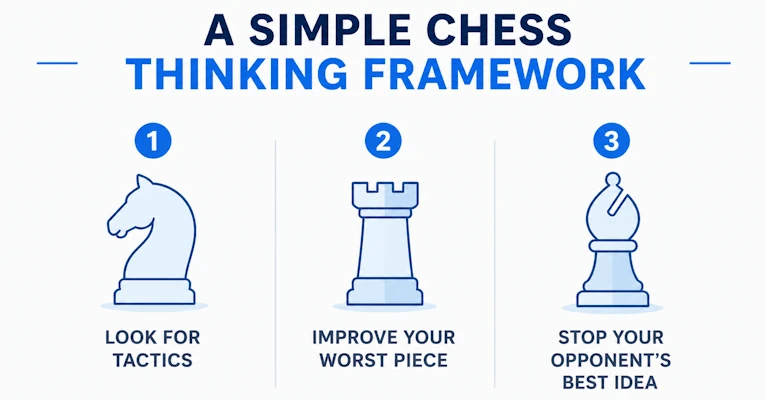
Chess positions can be complicated, but your overall thinking process can remain simple:
- Look for tactics.
- Improve your worst piece.
- Stop your opponent’s best idea.
The rest of this lesson explains the thinking behind each priority. These details are useful for understanding the framework, but they are not meant to become a longer checklist. During a game, you only need to remember the three main ideas. With practice, the details will become a natural part of your thinking.
1. Look for tactics
Tactics come first because they can decide the game immediately.
Before choosing a positional move, scan the whole board for:
- Checks, captures, and direct threats
- Undefended or vulnerable pieces
- Potential tactical resources
Look for tactical possibilities for both sides. Your opponent’s last move may have created a threat, but it may also have left something vulnerable.
If you find a tactical idea, assume your opponent will find the strongest reply. Calculate it carefully before deciding that the tactic works.
If no tactic works, move on and look for ways to improve your pieces. Trying to force a combination that the position does not support is a quick way to lose and make your opponent’s task easier.
2. Improve your worst piece
When there is no immediate tactic, identify the piece that contributes the least to your position.
Your worst piece is not necessarily your least valuable piece. It is the piece that is currently least useful because it is undeveloped, passive or poorly placed.
Ask:
Which of my pieces could perform a more useful role?
Improving a piece may seem too simple to be a serious strategy, but it is often the best way to make progress!
Improving a piece usually means:
- Moving it to a more active square
- Coordinating it better with your other pieces
- Giving it a useful attacking or defensive role
If you cannot improve your worst piece immediately, make it your strategy to create the conditions that will allow you to improve it—for example, by using a pawn break to open lines for your bishops or exchanging an enemy piece that restricts your development.
Repeating this approach gradually strengthens your position and creates better chances for future tactics.
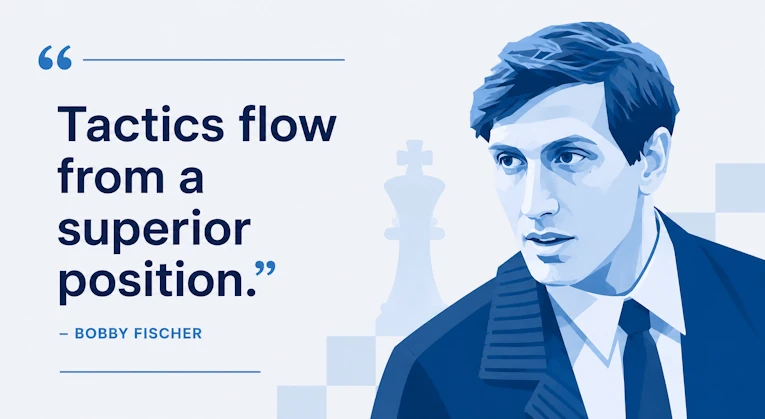
The well-known line attributed to Bobby Fischer expresses the connection between piece placement and tactics:
“Tactics flow from a superior position.”
Better piece activity and coordination often create the conditions from which tactics appear. A rook reaches an open file, a bishop enters an important diagonal, or a knight takes control of a key square. As the pieces become stronger, tactical opportunities become more likely.
This creates a natural cycle:
Look for tactics. Improve a piece. Look for tactics again.
3. Stop your opponent’s best idea
Your opponent is not waiting for you to carry out your plans. A strong opponent will also be looking for tactics, improving pieces and preparing useful ideas.
Your opponent’s last move often reveals what they are trying to achieve. Study it carefully, because it contains valuable information about their plans, threats and priorities.
After each opponent move, ask:
- What changed?
- What are they preparing?
- What would they play next if I ignored them?
Recognizing their idea early gives you time to stop it before it becomes dangerous.
Sometimes you should continue with your own plan. At other times, your opponent’s idea is more urgent and must be neutralised first.
The strongest solution is often a move that does both:
Improve your own position while making your opponent’s plan more difficult to achieve.
For example, you might develop a piece to a better square while creating a threat that forces your opponent into a passive defensive move. One move improves your position and, at the same time, limits your opponent’s options.
How to apply the framework during a game
The framework gives your thinking a clear order after every move. First understand what has changed, then decide whether the position calls for tactics, improvement or prevention.
1. Understand your opponent’s last move
Before considering your own move, identify what their move attacked, defended, improved or prepared. Their last move often reveals their immediate plan, but it may also have created a tactical weakness.
2. Check for tactics
Look for forcing moves and tactical opportunities for both sides. If a tactic works, it will usually take priority over a positional plan.
3. Choose the most important positional priority
If no tactic works, compare the two positional priorities:
- Improve your worst piece
- Stop your opponent’s best idea
Decide which is more urgent. The strongest move will often achieve both.
4. Test your intended move
Before playing a move, consider your opponent’s reply. Make sure your move is tactically sound and does not allow their plan to become more dangerous.
Bringing it all together
A useful thinking process should help you respond to both tactical and positional situations.
When a tactic exists, calculate it. When no tactic works, improve the piece that contributes the least while remaining alert to your opponent’s most important idea.
The framework is simple:
- Look for tactics.
- Improve your worst piece.
- Stop your opponent’s best idea.
I suggest you make it a habit to use this framework whenever you are unsure what to do.
Remember that it is not meant to be a rigid checklist. You only need to keep the three priorities in mind. With practice, they will become a natural part of your thinking.