The training plan on this page shows you what to focus on at each stage on your journey toward an 1800 lichess.org blitz rating—a level of chess strength that most amateur players never reach.
Just as importantly, the plan is designed to help you enjoy the process of improving. By giving you clear goals, practical exercises, and fun ways to play and train, it should make your journey more focused, rewarding, and enjoyable.
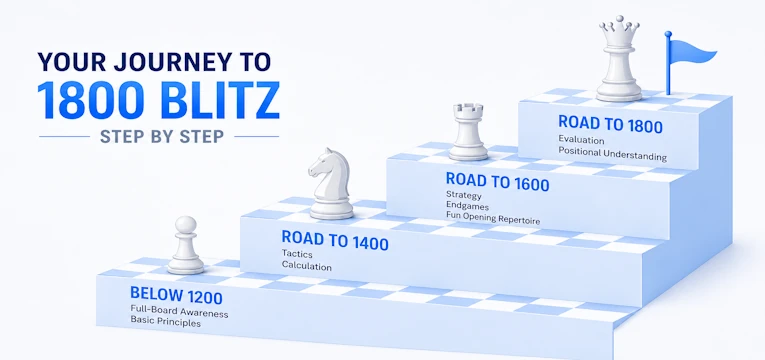
The plan is based on around 2 hours of training and 2 hours of playing per week. This 50/50 balance works well because training helps you build new skills, while playing gives you the chance to use them in real games. You can adjust the time to suit your needs—do more if you have the time, or less if needed.
Each stage builds on the previous one, so keep practicing the skills you have already learned while gradually adding new ones.
If you are already above the starting level, you can still work through the earlier recommendations at a faster pace. This can help you strengthen any important skills you may have missed.
How Long Will It Take?
Improving to 1800 is a long-term goal. With around 2 hours of training and 2 hours of playing per week, it could take roughly 1–3 years or longer.
How quickly you improve will depend on your previous experience, natural ability, consistency, and how well you apply what you learn. Some players will progress much faster than others.
Instead of worrying too much about the rating though, focus on training the skills needed to reach the next level.
Recommended Time Control
For this plan, I recommend 5-minute blitz (5+0) as your main playing time control. It is a great format for training specific skills because the faster pace forces you to concentrate, make decisions quickly, and apply what you have practiced under pressure.
During training exercises, however, slow down and practice deep concentration, careful calculation, and disciplined thinking. The goal is to develop specific skills through focused practice, then learn to apply them by playing blitz games.
Note: If you also play over-the-board chess at slower time controls, you should not count those games toward the 4-hour weekly blitz training plan.
Weekly Training Plans
The weekly training plans below show you what to focus on and how to divide your training time based on your current level.
Below 1200
At this level, focus on building strong board awareness, avoiding simple mistakes, and taking advantage of your opponent’s mistakes to gain material.
Playing Practice
Solve Mate-in-1 puzzles for 5 minutes as a warm-up, then play 5+0 blitz. Ideally, play 3–5 games per session and aim for 15–20 games per week.
Training Exercises
- Review your blitz games for obvious blunders and missed opportunities — 20 min
- Solve Mate-in-1 puzzles — 20 min
- Solve hanging-piece puzzles — 20 min
- Solve fork puzzles — 20 min
- Solve pin puzzles — 20 min
- Solve removing-the-defender puzzles — 20 min
Additional Study
Work through these at your own pace:
- The most important idea in chess – maximize piece activity
Weekly Training Time: ~2 hours (excluding playing time)
Road to 1400
At this level, focus on developing stronger tactical skills, improving the accuracy of your calculations, and building a solid understanding of the main chess principles.
Playing Practice
Solve Mate-in-1 puzzles for 5 minutes as a warm-up, then play 5+0 blitz. Ideally, play 3–5 games per session and aim for a total of 15–20 games per week.
Training Exercises
- Review your blitz games for obvious blunders and missed opportunities — 20 min
- Solve Mate-in-2 puzzles — 20 min
- Solve mixed tactical puzzles using CCT calculation method — 80 min
Additional Study
Work through these at your own pace:
- Tactical Understanding Course
- Study the top 5? chess principles.
Weekly Training Time: ~2 hours (excluding playing time and course study)
Road to 1600
At this level, focus on learning effective strategies, practical endgame techniques, and building a fun blitz opening repertoire.
Playing Practice
Solve Mate-in-2 puzzles for 5 minutes as a warm-up, then play 5+0 blitz. Ideally, play 3–5 games per session and aim for a total of 15–20 games per week.
Training Exercises
- Review your blitz games for obvious blunders and missed opportunities — 20 min
- Previous levels (15 min)
- Solve tactics in the opening stage
- Endgame positions to play
- Tactics in the endgame stage
- Visualwize – 20 min
Additional Study
Work through these at your own pace:
- The Top 5 Strategies
- Learn a Fun Blitz Repertoire
Weekly Training Time: ~2 hours (excluding playing time)
Road to 1800
At this level, focus on developing a deeper understanding of chess by learning to evaluate positions accurately, while continuing to strengthen the skills you developed at earlier levels.
Playing Practice
Solve Mate-in-2 puzzles for 5 minutes as a warm-up, then play 5+0 blitz. Ideally, play 3–5 games per session and aim for a total of 15–20 games per week.
Training Exercises
- Review your blitz games for obvious blunders and missed opportunities — 20 min
- review previous levels
- add evaluation
- Visualwize – 20 min
Additional Study
Work through these at your own pace:
Weekly Training Time: ~2 hours (excluding playing time)
Keep Moving Forward
Remember you do not need to master everything at once. Focus on the skills that matter most at your current level, keep training consistently, and give yourself time to improve.
Your rating may go up and down along the way, but if your skills are getting stronger, you are moving in the right direction.
Focus on the next step, keep improving, and let the rating follow.
ideas
Coordinates training
Mate-in-1 puzzles
Mate-in-2 puzzles
Mate-in-3 puzzles
Mate-in-4 / Mate-in-5+ puzzles
One-move puzzles
Hanging-piece puzzles
Checkmate patterns
Basic piece checkmates
Fork puzzles
Pin puzzles
Skewer puzzles
Discovered attacks
Double checks
Remove-the-defender puzzles
Trapped-piece puzzles
Exposed-king puzzles
Advanced tactical themes
Mixed / Healthy Mix puzzles
Puzzle Streak
Puzzle Storm
Puzzle Racer
Puzzle Dashboard
Improvement Areas
Review failed puzzles
Puzzles from your own games
Opening puzzles
Opening-phase puzzles
Middlegame puzzles
Endgame puzzles
Long puzzles
Slow calculation puzzles
Visualize before moving
Calculate the final position
Candidate-move training
Defensive puzzles
Quiet-move puzzles
Basic chess principles practice
Pawn endgames
Basic rook endgames
Practical rook endgames
Endgame tablebase practice
Endgame positions vs computer
Opening Explorer
Personal opening review
Lichess opening Study
Opening recall practice
Opening mistake review
Opening-specific tactics
Annotated master games
Pause-and-predict training
Strategy position training
Engine-off game review
Critical-moment review
Blunder review
Learn From Your Mistakes
Save mistakes to a Study
Repeat your own mistakes
Chess Insights review
Position evaluation drills
Evaluation guessing
Compare both sides
Plan-finding exercises
Candidate-move comparison
Master-game evaluation
Skill-focus blitz games
Post-session review
Hyperfocus puzzle sessions
Hyperfocus blitz games
Puzzle accuracy challenge
Pattern-repetition sessions
Mixed-recognition sessions
Easy-to-hard puzzle sessions