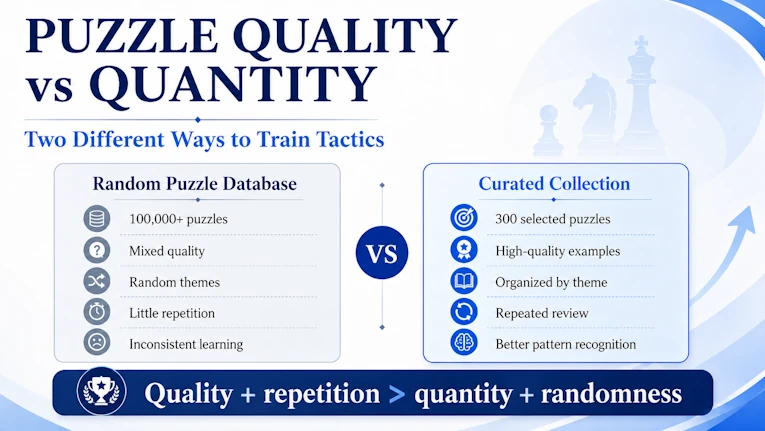
Many chess players train tactics by solving random puzzles from large online databases. These databases can be useful, but they have a serious limitation: the quality of the puzzles is highly inconsistent.
Some puzzles are excellent. Others make sense only to an engine. If your goal is to build pattern recognition, low quality puzzles will frustrate you.
Pattern Recognition Requires Repetition
A database may give you a puzzle once, and then you may never see it again. That is not the best way to learn tactical patterns.
To recognize an idea quickly, you need repeated exposure to clear examples of that idea. Instead of constantly seeing new positions, you should review the most important patterns until they become familiar.
Random Puzzles Create Random Results
Large databases often serve a strange mix of material. One puzzle may show a rare tactical motif. The next may be an obscure endgame idea or you may face a position where the solution makes sense only because the engine says one side is better.
The frustrating part is that you usually discover this only after spending time trying to solve the puzzle. Instead of learning a useful pattern, you end up confused by a position that was never ideal training material in the first place. And even when databases allow you to use a filter, there is still no guarantee that the next puzzle will be good training material.
Simple Examples Teach Better
Online tactics databases usually track your puzzle rating. Because of this, it is natural to put in extra effort to keep your rating as high as possible.
But this can become counterproductive.
Higher-rated puzzles are harder, but harder does not always mean better. When studying tactics, simple examples are often more effective. The pattern is easier to see, easier to understand, and easier to remember.
More Isn’t Always Better
If you solve tons of puzzles, your understanding of the patterns can remain vague. You may see many positions, but fail to deeply learn the most important patterns because your focus isn’t on one theme at a time.
For that reason, a smaller collection of carefully selected puzzles reviewed many times can be more valuable than solving tons of random puzzles once.
What Should You Do?
One option is to create your own collection of high-quality tactical positions. Save the best examples you find, organize them by theme, and review them regularly. This takes time because you have to work through many exercises to find the best ones, but the process itself can also be useful.
The easier option is to use a collection that has already been selected and organized for this purpose.
That is why I created 300 Essential Tactical and Checkmate Patterns.
300 Essential Tactical and Checkmate Patterns
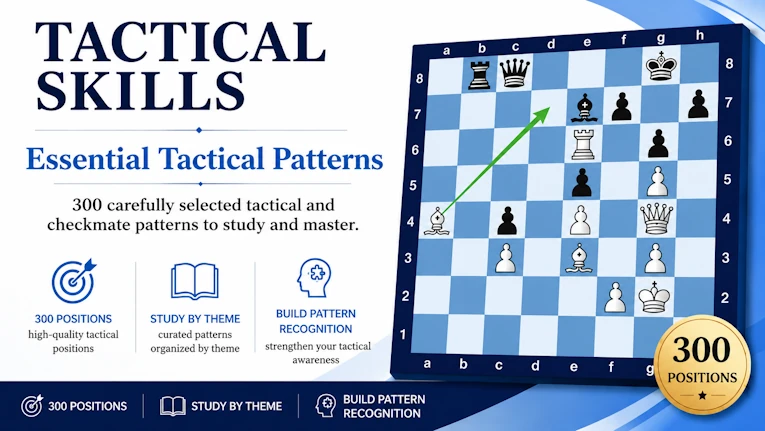
Build your tactical pattern recognition systematically instead of relying on random puzzles.
This collection contains 300 carefully selected tactical and checkmate patterns organized into 20 themes, including forks, pins, skewers, discovered attacks, X-rays, checkmate patterns, and more.
The goal is not to solve these positions once and move on, but to review them until the patterns become instantly recognizable.
Price: $30