In this lesson, I’ll introduce you to a practical chess thinking framework that can help you think more clearly during a game.
The 3 Pillars of a Clear Chess Thinking Process
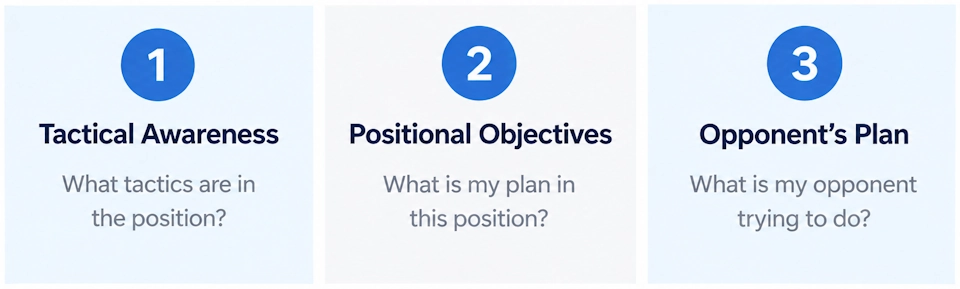
An effective chess thinking process rests on three pillars:
- Tactical Awareness: What tactical opportunities or dangers are there?
- Positional Objectives: What should I try to achieve in this position?
- Opponent’s Plans: What does my opponent want to do?
Let’s look at why each pillar matters.
1. Tactical Awareness — What tactical opportunities or dangers are there?
Chess is full of tactical possibilities. A piece might be hanging, a combination might be available, or your opponent might be threatening something you haven’t noticed.
Before committing to a move, you need to understand the immediate tactical possibilities and dangers. Otherwise, you might spend time developing a long-term plan only to lose a piece or miss a tactical opportunity.
When you’re aware of the tactics, you can think more calmly about your positional objectives, knowing that you’ve considered the immediate threats.
Learn more: Tactical Awareness — How to Recognize Tactical Opportunities and Dangers
2. Positional Objectives — What should I try to achieve in this position?
Once you’ve considered the tactics, you need to decide what you’re trying to achieve.
Should you improve your worst-placed piece, control an important square, attack a weakness, or prepare a pawn break? The answer depends on the position. There is no single rule that tells you what to do in every situation.
Your positional understanding helps you recognize what matters most and choose an objective that makes sense for the position.
Without a clear objective, you can easily drift from move to move without making meaningful progress.
Learn more: Positional Objectives — How to Find What Matters in a Position
3. Opponent’s Plans — What does my opponent want to do?
Chess is not played in isolation. While you’re working towards your own objectives, your opponent is trying to achieve theirs.
They might be preparing an attack, improving a poorly placed piece, or creating a threat that will force you to react. If you focus only on your own ideas, you risk overlooking what your opponent is trying to do.
By considering their plans, you can anticipate threats, prevent important ideas, and make better decisions about when to pursue your own objectives and when to respond to theirs.
Learn more: Opponent’s Plans — How to Anticipate Your Opponent’s Ideas
Follow the links in the lesson to learn more about each of the three pillars.