Mate-in-2 puzzles are one of the best ways to learn checkmate patterns because they give you the perfect balance between seeing the final pattern and understanding how it can be created.
A mate-in-1 puzzle shows the final checkmate clearly. You see the result, but not the idea that made it possible.
Longer checkmates can also be valuable, but you may need to calculate several variations or find a precise move order. That is good calculation training, but it can distract from learning the main checkmate idea.
Mate-in-2 puzzles sit in the middle. They are short enough that the checkmate pattern remains clear, but long enough to show how the pattern is prepared.
Example: Anastasia’s Mate
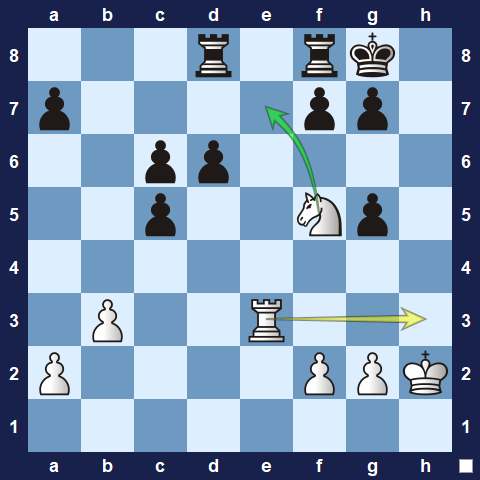
1. Ne7+ Kh7 2. Rh3# shows the final checkmate pattern, but also illustrates how the knight can help force the king into position before the rook delivers mate.
In many mate-in-2 puzzles, the first move does something important. It may remove an escape square, deflect a defender, open a line or force the king into a weaker position. Then the second move delivers the checkmate.
This is why I use mate-in-2 puzzles in the checkmate section of 300 Essential Tactical and Checkmate Patterns. They help you study the final pattern and the typical setup behind it, without making the exercise unnecessarily complicated.
300 Essential Tactical and Checkmate Patterns
Build your tactical pattern recognition systematically instead of relying on random puzzles.
This collection contains 300 carefully selected tactical and checkmate patterns organized into 20 themes, including forks, pins, skewers, discovered attacks, X-rays, checkmate patterns, and more.
Unlike a typical puzzle collection, the goal is not to solve these positions once and move on, but to review them until the patterns become instantly recognizable.
Price: $30